

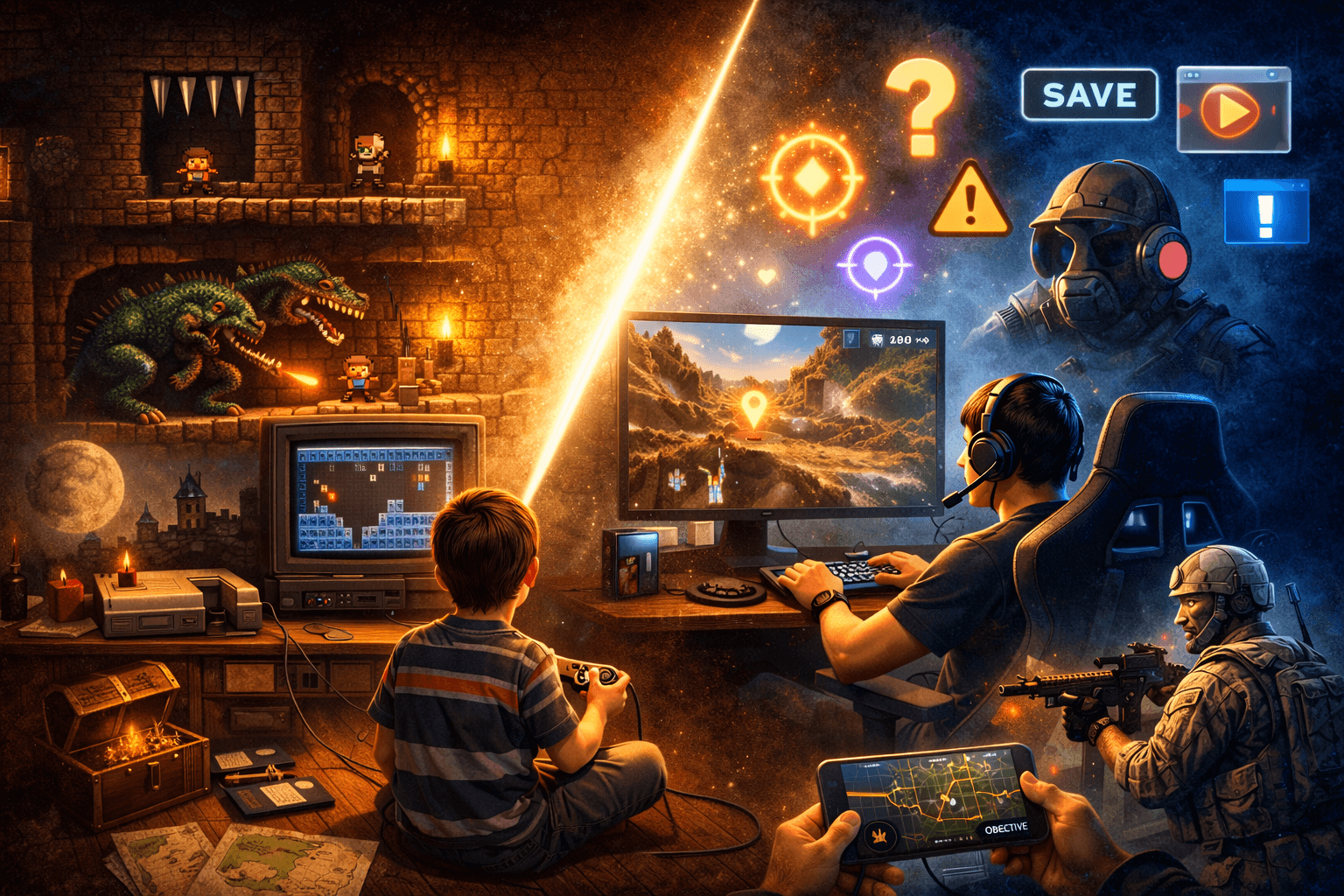
The Forgotten Cognitive Gym of Old-School Gaming
If you were born in the 1980s or 1990s, you didn’t grow up with tutorials, glowing arrows, minimaps, quest logs, autosave every 30 seconds, or YouTube walkthroughs.
You grew up with:
- No explanations
- No hints
- No mercy
- No save points (or extremely rare ones)
- No internet help
- And absolutely no forgiveness
Games were not just entertainment.
They were cognitive survival challenges.
You didn’t play.
You studied, memorized, experimented, failed, and adapted.
And this trained your brain in ways modern games simply do not.
Trial, Error and Mental Mapping
Old games like:
- Zelda (NES / SNES)
- Metroid
- Prince of Persia
- Monkey Island
- Resident Evil
- Diablo I
- Tomb Raider
- Mega Man
- Castlevania
did not give you a map that updated itself.
You built mental maps.
You remembered:
- Where enemies spawn
- Which rooms connect
- Which puzzles you already tried
- Where you died
- Where you might still have secrets
That is spatial reasoning, memory consolidation and pattern recognition training — the same skills used by engineers, developers and architects.
Saving Was a Strategic Decision
Modern players save automatically.
Old-school players had to earn the right to save.
Sometimes you could only save:
- At special rooms
- After specific items
- After finishing entire zones
- Or not at all
This forced:
- Long-term planning
- Risk management
- Emotional control
- Decision consequence evaluation
You learned to think ahead, because mistakes were expensive.
Zero Tutorials = Pure Logical Deduction
You were dropped into worlds with no instructions.
You had to deduce:
- What items do
- Which enemies are vulnerable to what
- What a weird symbol might mean
- How mechanics interact
That’s raw logical reasoning.
Not following steps.
Not watching guides.
Not clicking glowing buttons.
You discovered systems.
Which is exactly what programmers, hackers and engineers do in real life.
Modern Games Removed Cognitive Pressure
Today:
- Arrows show where to go
- Maps reveal everything
- NPCs repeat hints
- YouTube solves the game for you
- Autosave forgives every mistake
- Objectives blink on screen
Modern games reward reaction, not reasoning.
They removed:
- Memory dependency
- Strategic planning
- Failure consequence
- Discovery through deduction
So the brain trains less.
Result: Two Different Cognitive Profiles
| Old-School Generation | Post-2000 Generation |
|---|---|
| Thinks before acting | Acts before thinking |
| Plans routes mentally | Follows waypoints |
| Accepts failure as data | Expects forgiveness |
| Discovers mechanics | Follows instructions |
| Builds mental maps | Reads minimaps |
| Strong logical deduction | Strong reflex reaction |
Both can be skilled.
But only one was forced to grow logic muscles.
The Real Conclusion
Games of the 80s and 90s were not harder.
They were less forgiving.
And unforgiving systems force:
- Analysis
- Memory
- Planning
- Emotional control
- System comprehension
Which is why that generation accidentally trained their brains like engineers — without knowing it.
They didn’t just play.
They were being cognitively forged.



0 Comentários